


No-shows are an unavoidable reality for most healthcare practices. While most recognize them as a problem, few have taken the time to formally measure their frequency or understand the true scope of their impact.
However, if you’re only noticing the empty slots on your calendar, you may be missing the bigger picture. Without knowing how to calculate your no-show rate, it’s difficult to see how much missed appointments are actually costing your practice, or whether your efforts to reduce them are working.
Fortunately, getting that number doesn’t require a complicated analysis.
With just two data points, you can establish a reliable baseline, compare your practice against industry benchmarks, and start identifying patterns behind missed appointments.
Below, we’ll walk through:
- How to calculate your no-show rate
- What a healthy rate looks like across different specialties
- What missed appointments may be costing your practice.
We’ll also cover practical, evidence-backed strategies you can use to improve attendance and keep your schedule full.
Key Takeaways
- Calculating your no-show rate is simple: Divide the number of missed appointments by your total scheduled appointments, then multiply by 100.
- Even a seemingly modest no-show rate can add up. Industry data suggests most specialties have a median no-show rate around 5%, while some specialties experience considerably higher rates.
- No-shows affect more than your calendar. Missed appointments can mean lost revenue, wasted staff time, lower provider productivity, and disruptions to continuity of care.
- Automated appointment reminders can make a measurable difference. Two-way text messaging also gives patients an easy way to confirm, cancel, or reschedule before an appointment becomes an empty slot.
- The strongest approach is systematic. Pair reminders with convenient scheduling, a clear cancellation policy, operational efficiency, an actively managed waitlist, and ongoing tracking to understand where—and why—no-shows happen.
What Is a No-Show Rate?
Your no-show rate is the percentage of scheduled appointments where a patient neither arrives nor cancels in advance. A true no-show occurs when a patient misses an appointment without notifying the practice. A late cancellation occurs when a patient cancels after the practice’s established cancellation deadline, while a same-day cancellation occurs when a patient cancels at any point on the scheduled appointment date. A late arrival occurs when a patient comes to the appointment but arrives after the scheduled start time.
These distinctions matter because they affect how you calculate your no-show rate and apply your cancellation policy, so it’s important to define each category consistently before you begin tracking and defining these metrics in your systems.
How to Calculate Your No-Show Rate
Calculating your no-show rate only requires two numbers: the total number of appointments that were scheduled and the number of no-shows.
The Formula
To calculate your no-show rate, use the following formula:
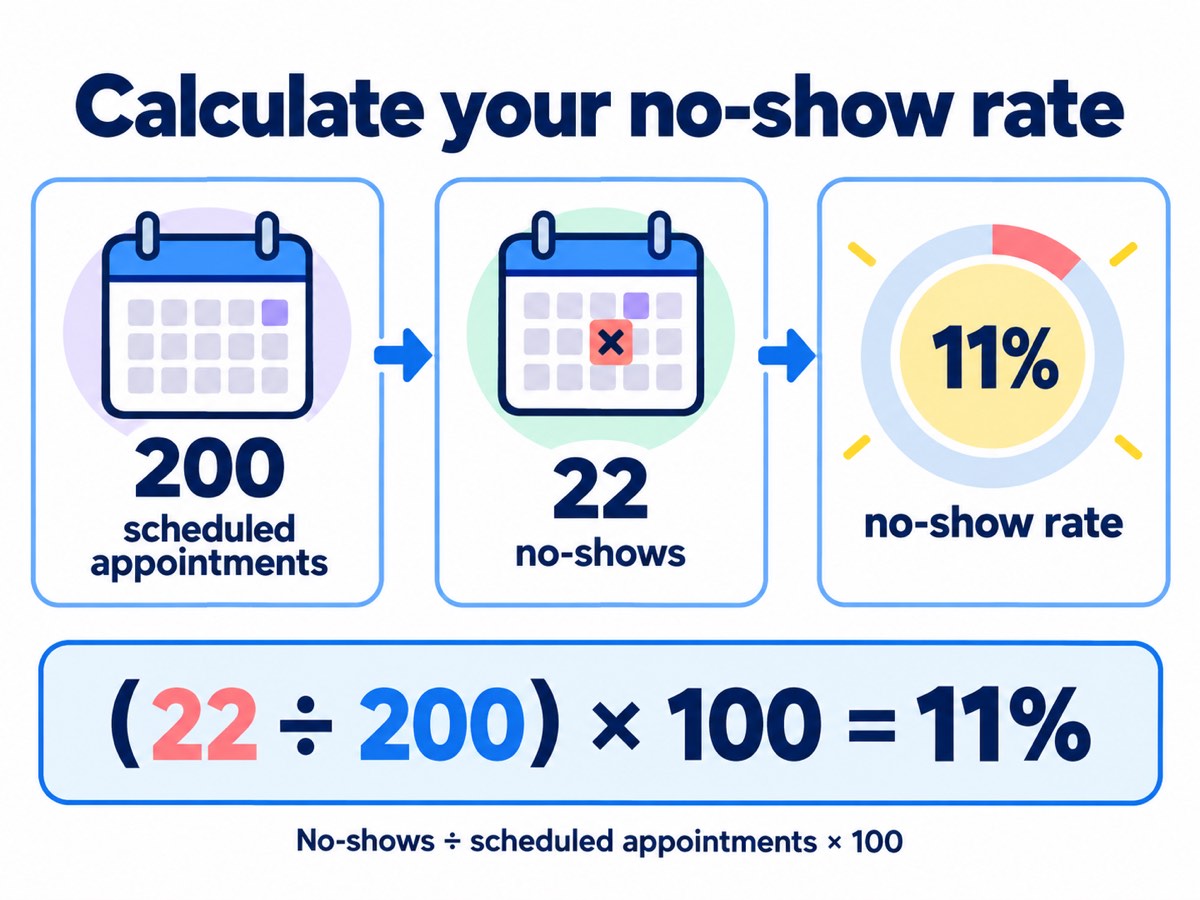
No-Show Rate = (Missed Appointments ÷ Total Scheduled Appointments) × 100
Most practice management or scheduling systems already track both figures, so you will likely be able to pull the information you need in just a few clicks.
Once you have those numbers, divide your missed appointments by your total scheduled appointments and multiply the result by 100. The final percentage is your practice’s no-show rate for that period.
Example
Say your practice scheduled 200 appointments last month, and 22 patients didn’t show up.
Your calculation would look like this:
(22 ÷ 200) × 100 = 11%
Your practice’s no-show rate for the month would therefore be 11%.
Once you have this baseline, you can begin comparing your rate over time and look for patterns. For example, you may discover that certain appointment types, providers, days of the week, or longer booking lead times are associated with more missed appointments.
What to Include (and Exclude)
For the most accurate no-show rate calculation, only include appointments that were actually scheduled with your practice. Walk-ins shouldn’t be included because there was no scheduled appointment to miss. You should also exclude appointments that your practitioners canceled or rescheduled.
Same-day cancellations are a little less straightforward. Some practices count them alongside no-shows because the short notice leaves little opportunity to refill the appointment. Others track them separately.
Either approach can work. What matters most is choosing a definition and applying it consistently.
If the way you categorize missed appointments changes from month to month, it becomes much harder to tell whether your no-show rate is actually improving.
Try tracking the same way for at least three to six months. A single month gives you a snapshot, but several months of consistent data can reveal patterns that help you find meaningful solutions to trends.
After this period, you can review your metrics and determine if it makes sense for your business to include same-day cancellations, or if keeping them separate makes more sense to your team.
What’s a Good No-Show Rate?
Once you know your no-show rate, the next question is usually: Is it good or bad?
There isn’t one universally “good” no-show rate number that applies to every healthcare practice. No-show rates vary considerably depending on specialty, patient population, location, appointment type, and even how an organization defines a no-show.
According to the MGMA 2016 Practice Operations Report, most specialties had a median no-show rate of around 5%, with neurology and general surgery reaching approximately 8%. Other industry research has reported substantially higher rates across individual specialties.
For example, reported no-show rates include:
It is important to note that your own baseline will ultimately be the more valuable benchmark.
If your practice has historically had a 12% no-show rate and it drops down to 8%, that improvement translates into appointments recovered, better-utilized provider time, and potentially significant revenue retained.
That’s why tracking your rate consistently matters more than chasing a single industry-wide target.
What Missed Appointments Are Really Costing Your Practice
An empty appointment slot may look like a small gap in the schedule. Across hundreds or thousands of appointments, however, those gaps can turn into a significant operational expense.
And the financial impact is only part of the story.
The Direct Revenue Loss
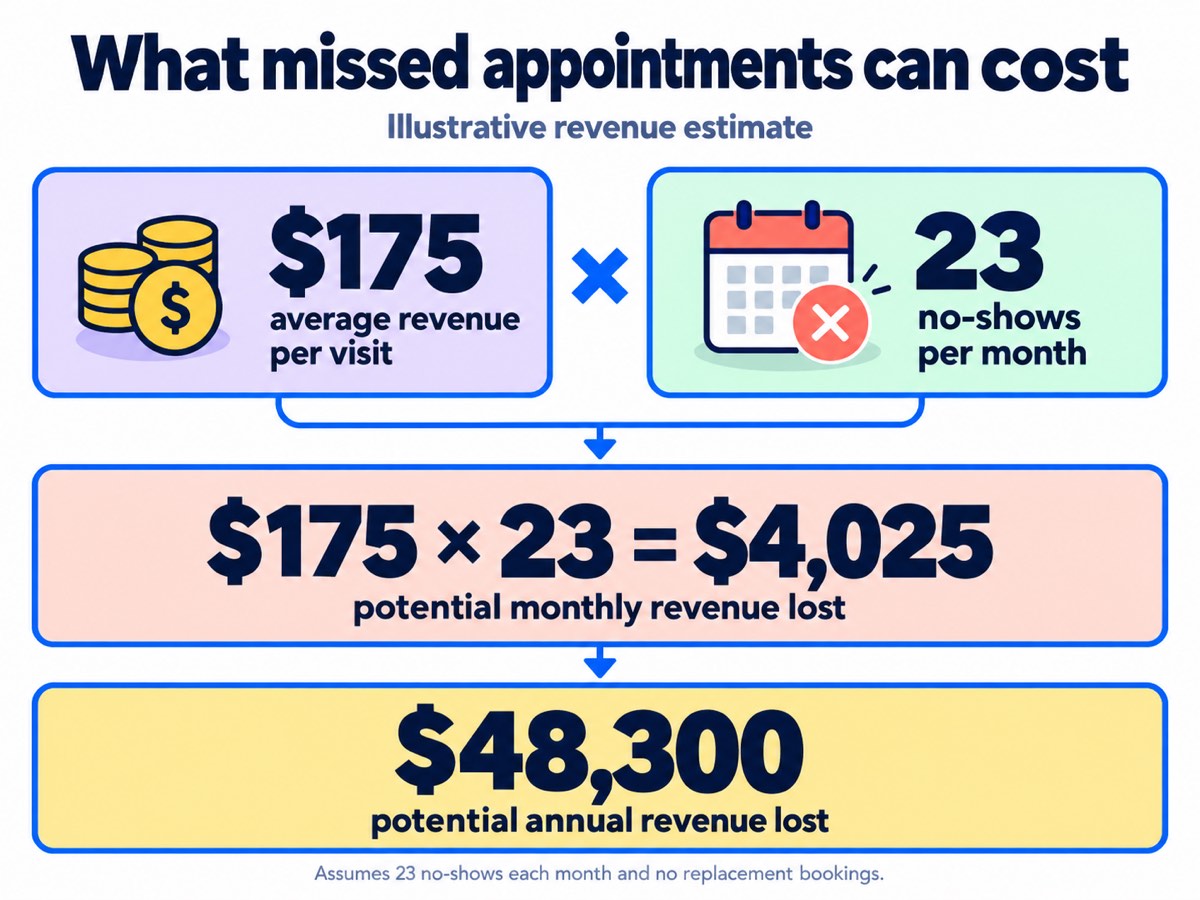
One simple way to estimate the financial impact of no-shows is to multiply the average revenue generated by an appointment by the number of appointments missed each month:
Average Revenue Per Appointment × Monthly No-Shows = Estimated Monthly Revenue Loss
For example, imagine a practice averages $175 in revenue per completed appointment and records an average of 23 no-shows per month:
$175 × 23 = $4,025 in potential monthly revenue
Over a year, those missed appointments could represent $48,300 in potential revenue.
Research and industry data show how quickly these losses can add up in real-world settings. One estimate suggests providers lose roughly $7,500 per month on average due to no-show appointments.
In another real-world example, researchers examining a vascular laboratory found that a 12% no-show rate was associated with an estimated annual gross loss of $89,107.
Putting your no-show rate into dollars reveals what missed appointments are actually costing your practice, not just in lost revenue, but in valuable time and capacity that could have gone to other patients.
How No Shows Affect the Rest Of Your Practice
Lost appointment revenue is the easiest cost to calculate, but it isn’t the only one your practice absorbs.
- Staff time: Front-desk staff, medical assistants, and clinicians may all spend time preparing for an appointment that never happens. Without a completed visit, that labor has no corresponding billable service.
- Provider productivity: A missed appointment creates downtime that may be difficult to recover, particularly when your team doesn’t have enough notice to offer the opening to another patient.
- Patient churn: Repeated missed appointments can signal disengagement from care. Without an effective way to reconnect with patients, a no-show can eventually become a lost patient.
- Continuity of care: For patients managing chronic or ongoing conditions, missed appointments can interrupt treatment plans and delay necessary follow-up. What begins as a scheduling problem can become a care problem.
This is what makes no-shows more than an inconvenience. Every missed appointment creates a ripple effect across your practice, affecting revenue, staff efficiency, provider schedules, and the patients who depend on consistent care.
Once you understand that impact, the goal isn’t simply to fill every possible slot. It’s to understand why patients are missing appointments so your practice can address the root cause.
Why Patients No-Show
There’s rarely one reason behind a missed appointment. Understanding what’s driving no-shows in your practice can help you address the causes you can actually control.
Behavioral Reasons
Some of the most common patient-level reasons include:
- Forgetfulness: Patients simply forget, particularly when appointments are booked weeks or months in advance.
- Transportation barriers: Getting to an appointment isn’t always easy. Millions of Americans delay medical care each year because they lack reliable transportation.
- Cost or insurance concerns: Unexpected out-of-pocket costs, uncertainty about coverage, or financial strain can cause patients to skip care.
- Appointment anxiety: Fear of a diagnosis, procedure, or the appointment itself can make avoidance feel easier than showing up, particularly in settings such as dental and behavioral healthcare.
- Feeling better: Patients may decide a follow-up or specialist visit is no longer necessary once their symptoms improve.
- Scheduling conflicts: Work, childcare, family responsibilities, and other unexpected obligations can quickly turn a planned appointment into a missed one.
Structural and System-Level Reasons
Not every no-show starts with the patient. Sometimes, barriers within the practice or care experience contribute to missed appointments.
- Outdated contact information: An old phone number or email address means appointment reminders may never reach the patient.
- Scheduling and routing mismatches: Patients may be booked with the wrong provider or for the wrong visit type, creating confusion or making the appointment less relevant to their needs.
- Long appointment lead times: The longer patients wait between booking and their appointment, the more opportunity there is to forget, lose urgency, or encounter a scheduling conflict. Try to find a good balance of planning in advance without scheduling patients too far out.
- Poor patient-provider connection: The patient experience can influence whether people return for scheduled care. Research has linked better experiences with care providers to fewer subsequent no-shows, while poor doctor-patient relationships, issues with staff, and friction in the booking and exploration processes have been linked to increased no-shows.
The takeaway: No-shows aren’t always a patient behavior problem. Looking at your scheduling, communication, and overall patient experience can reveal opportunities to improve attendance from within your practice.
How to Reduce Your No-Show Rate
Once you understand your baseline and the factors behind it, you can start addressing no-shows systematically. Here are some actionable tips you can use to begin improving your patient attendance rate:
Send Automated Appointment Reminders
SMS appointment reminders are one of the most straightforward ways to reduce no-shows.
Research shows that both automated reminders and manual phone calls can reduce no-shows, but using the two together can be more effective than relying on either approach alone. Sending well-timed reminders and experimenting with these approaches may also improve attendance.
Instead of relying on one message, build reminders into several points of the patient journey. For example, when the appointment is booked, shortly before the visit, and on the day of the appointment.
Two-way texting makes those reminders more actionable. With a HIPAA-compliant messaging platform, patients can confirm, cancel, or request to reschedule by replying to the message.
That allows your team to act on a cancellation and potentially fill the opening before it becomes lost time.
Make appointment reminders easier to act on. Textline helps healthcare practices automate reminders and communicate with patients through two-way, HIPAA-compliant texting—so patients can respond and your team can address schedule changes sooner.
Let Patients Self-Schedule
Patients increasingly expect convenient digital scheduling options, and giving them more control can make it easier to choose an appointment that actually fits their schedule.
Nearly nine in 10 patients say convenient options such as self-scheduling and texting can influence their choice of healthcare practice.
Self-scheduling can also reduce manual data entry by letting patients provide or update their own contact information. More accurate contact information means a better chance that appointment reminders reach the right person.
Build and Actively Work a Waitlist
A cancellation doesn’t have to become an empty slot. An active waitlist gives your team a pool of patients who may be willing to come in sooner.
Keep the list current and note which patients have flexible schedules or want an earlier appointment. When a slot opens, work through the most appropriate patients quickly and have a consistent process for offering and confirming the appointment. The easier it is for your team to identify who to contact and fill the opening, the more useful your waitlist becomes.
Automate Follow-Ups With Agentic AI
Agentic AI is a type of AI that can communicate with patients and take action on their behalf based on the goals and rules you set. These agents can work much like a chatbot or virtual staff member, communicating through text, chat, or even voice. For example, when an appointment is canceled, an AI agent could automatically reach out to patients on a waitlist, have a conversation about their availability, answer routine scheduling questions, offer an appropriate open time, and book the appointment once the patient agrees.
That ability can help practices automate much more of the follow-up process from start to finish. With appropriate privacy safeguards, permissions, and oversight, practices can use agentic AI to reduce administrative work and give employees more time to focus on patients and other higher-value tasks.
Set a Clear No-Show Policy
A clear policy sets expectations before a missed appointment happens. Define your cancellation window—often 24 to 48 hours—and explain any applicable fees during intake and in your written policies.
If you charge a no-show fee, communicate it clearly in advance and apply it consistently. The AMA considers reasonable missed-appointment fees ethical when patients are notified beforehand, and the fee follows the practice’s published policy.
But fees aren’t the only tool available, and they may create another barrier for patients already struggling with cost. Start by making it easier to remember, cancel, and reschedule appointments; use financial penalties thoughtfully rather than as your first line of defense.
Address Transportation Barriers Directly
Transportation can be the difference between a scheduled appointment and a completed one.
Nearly six million Americans were estimated to delay medical care because of transportation barriers in 2017.
Depending on your practice and patient population, consider offering directions in reminder messages, connecting patients with available transportation or rideshare resources, or offering telehealth when clinically appropriate.
Track by Segment, Not Just Practice-Wide
Your overall no-show rate only tells part of the story. Break the number down by provider, visit type, appointment lead time, and day of the week to see where missed appointments are actually concentrated.
Establish a baseline before introducing a new reminder strategy or policy, then watch the trend over time rather than overreacting to a single month. Segment-level data lets you focus your efforts where they can make the biggest difference.
Your No-Show Rate Is Just the Starting Point
Calculating your no-show rate tells you how often appointments are falling through. Breaking that number down and understanding why shows you where the opportunities for improvement lie.
One of the simplest places to start is better communication. Automated reminders keep appointments top of mind, while two-way texting gives patients an easy way to respond when their plans change. That means fewer surprises for your front desk and more opportunities to keep your schedule full.
With Textline, healthcare practices can automate SMS reminders and give patients a convenient, HIPAA-compliant way to communicate with their care team.
[See How Textline Reduces No-Shows]
Frequently Asked Questions
What’s the difference between a no-show and a late cancellation?
A no-show occurs when a patient misses an appointment without notifying the practice. A late cancellation occurs when the patient does cancel, but after the practice’s established cancellation deadline. Define both clearly in your policy so your staff tracks them consistently.
How often should I calculate my no-show rate?
Calculate your no-show rate monthly so you can identify trends without putting too much weight on normal week-to-week variation. Higher-volume practices may also benefit from reviewing weekly or bi-weekly data alongside monthly trends.
How do I communicate a no-show fee without damaging the relationship?
Be clear, consistent, and respectful. Explain the policy during intake, provide it in writing, and frame it around protecting appointment availability for all patients. Give patients an easy way to cancel or reschedule before the deadline whenever possible.
Are text reminders more effective than phone calls?
Both text and phone reminders can reduce missed appointments. Manual phone calls have performed particularly well in some research, while SMS offers the advantage of automation, scalability, and easy two-way communication. For some practices, combining methods may be appropriate for higher-risk appointments.
What no-show rate should trigger a formal intervention?
There isn’t one universal cutoff because no-show rates vary considerably by specialty, patient population, and appointment type. Instead, establish your practice’s baseline and look for sustained increases, costly patterns, or specific segments with unusually high rates. If missed appointments are regularly leaving providers idle, delaying access, or reducing revenue, it’s worth taking action.